Warehouse Concrete Flooring Construction: Complete Guide for Industrial & Logistics Facilities
Warehouse concrete flooring construction plays a critical role in the performance, safety, and durability of modern logistics, industrial, and storage facilities. Unlike conventional building floors, warehouse floors are designed to withstand heavy loads, continuous forklift traffic, high racking systems, and demanding operational conditions. A poorly designed or executed concrete floor can lead to cracks, joint failures, uneven surfaces, operational delays, and increased maintenance costs.
With the rapid expansion of industrial zones, logistics hubs, manufacturing plants, and distribution centers, demand for high-performance warehouse concrete flooring has grown significantly across Saudi Arabia and the GCC region. This article provides a comprehensive guide to warehouse concrete flooring construction, covering design considerations, construction methods, materials, joint systems, finishing techniques, quality control, and long-term performance.
Importance of Concrete Flooring in Warehouses
Concrete flooring is the backbone of warehouse operations. It directly affects:
-
Forklift efficiency and safety
-
Load-bearing capacity
-
Racking system stability
-
Operational productivity
-
Maintenance and lifecycle cost
Warehouse floors must remain flat, level, durable, and crack-controlled throughout their service life. Even small surface irregularities can cause forklift vibration, rack damage, and operational inefficiencies.
Types of Warehouse Concrete Flooring
1. Conventional Reinforced Concrete Floors
Traditional reinforced concrete slabs use steel reinforcement (rebar or mesh) to control cracking and improve load capacity. These floors are suitable for medium-load warehouses with standard storage operations.
2. Fiber-Reinforced Concrete Floors
Steel fiber or synthetic fiber reinforcement is increasingly used in warehouse floors to:
-
Reduce or eliminate conventional reinforcement
-
Improve crack control
-
Increase impact resistance
-
Enhance load distribution
Fiber-reinforced concrete is widely adopted in large logistics warehouses and industrial facilities.
3. Jointless or Large-Panel Floors
Jointless floors minimize construction joints by using:
-
High-performance concrete
-
Advanced fiber reinforcement
-
Controlled pouring sequences
These floors reduce joint maintenance and improve forklift movement.
4. Heavy-Duty Industrial Floors
Designed for:
-
High-load racking systems
-
Heavy machinery
-
Industrial manufacturing environments
They include thicker slabs, stronger concrete grades, and enhanced sub-base preparation.
Key Design Considerations for Warehouse Concrete Floors
Load Requirements
Warehouse floors must be designed to accommodate:
-
Static loads (racks, stored goods)
-
Dynamic loads (forklifts, pallet movers)
-
Point loads from racking legs
Load calculations influence slab thickness, reinforcement type, and concrete strength.
Subgrade and Sub-Base Preparation
A warehouse floor is only as strong as the ground beneath it. Proper preparation includes:
-
Soil investigation
-
Compaction to required density
-
Granular sub-base installation
-
Vapor barrier placement
Poor subgrade preparation is one of the leading causes of floor failure.
Flatness and Levelness (FF & FL)
High-bay warehouses require strict compliance with FF (Floor Flatness) and FL (Floor Levelness) standards to ensure safe and efficient material handling. Laser screed technology is commonly used to achieve these tolerances.
Concrete Materials and Mix Design
Concrete Grade
Warehouse floors typically use concrete grades ranging from:
-
C30 to C40 for standard warehouses
-
C45 to C50 for heavy-duty and industrial applications
The mix design must balance strength, workability, and shrinkage control.
Admixtures
Modern concrete flooring uses admixtures such as:
-
Superplasticizers for workability
-
Shrinkage-reducing agents
-
Accelerators or retarders (as required)
These improve performance and finishing quality.
Construction Methodology
1. Site Preparation
-
Surveying and setting out
-
Compaction testing
-
Installation of vapor barriers and insulation (if required)
2. Formwork and Joint Layout
-
Edge forms and joint profiles installed
-
Expansion, contraction, and construction joints planned carefully
Joint layout directly impacts floor durability.
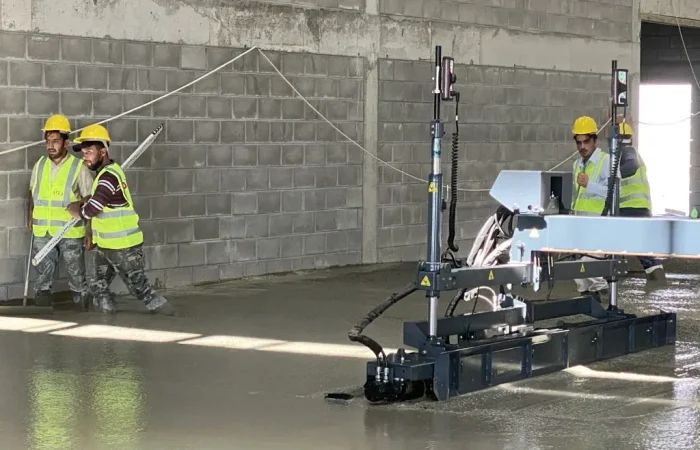
3. Concrete Placement
Concrete is placed using:
-
Direct discharge
-
Pumps
-
Laser screed machines
Laser screeds ensure uniform thickness and excellent surface flatness.
4. Surface Finishing
Finishing methods include:
-
Power troweling
-
Dry shake hardener application
-
Steel trowel finishing
Surface finish depends on operational requirements.
5. Curing
Proper curing is essential to:
-
Achieve design strength
-
Reduce cracking
-
Improve abrasion resistance
Curing methods include curing compounds or water curing.
Joint Systems in Warehouse Floors
Contraction Joints
Control shrinkage cracking and are typically cut within 24 hours.
Expansion Joints
Allow movement between structural elements.
Armored Joints
Used in high-traffic areas to protect joint edges from forklift damage.
Surface Hardening & Floor Finishes
Dry Shake Floor Hardeners
Applied during finishing to improve:
-
Abrasion resistance
-
Surface durability
-
Dust reduction
Available in metallic and non-metallic options.
Polished Concrete Floors
Increasingly popular for warehouses due to:
-
Dust-free surface
-
Low maintenance
-
Improved light reflectivity
Epoxy & Protective Coatings
Used in specialized warehouses such as:
-
Cold storage
-
Chemical storage
-
Food & pharmaceutical facilities
Quality Control & Testing
Quality assurance includes:
-
Slump testing
-
Cube or cylinder strength tests
-
Flatness and levelness measurement
-
Joint inspection
Strict QA/QC ensures long-term performance.
Common Issues in Warehouse Concrete Floors
-
Cracking due to poor curing
-
Joint spalling from heavy traffic
-
Uneven settlement
-
Surface dusting
These issues are usually caused by poor design or execution.
Maintenance & Long-Term Performance
Proper maintenance includes:
-
Joint repair
-
Surface re-polishing
-
Crack sealing
Well-constructed warehouse floors can last 30–50 years with minimal maintenance.
Warehouse Concrete Flooring in Saudi Arabia
Saudi Arabia’s climate presents unique challenges:
-
High temperatures
-
Rapid evaporation
-
Thermal movement
Concrete flooring contractors must adapt mix design, curing methods, and construction timing to local conditions.
Sustainability & Modern Practices
Modern warehouse floors focus on:
-
Reduced cement content
-
Long-life design
-
Low-maintenance surfaces
This supports sustainability and operational efficiency.
Choosing the Right Warehouse Concrete Flooring Contractor
Key criteria include:
-
Proven industrial experience
-
Skilled workforce
-
Advanced equipment (laser screeds)
-
Strong QA/QC systems
Selecting the right contractor ensures cost-effective and durable flooring.
Warehouse concrete flooring construction is a specialized discipline requiring engineering expertise, precision execution, and strict quality control. From subgrade preparation to final finishing, every stage impacts performance and lifecycle cost.
As warehouse and logistics facilities continue to expand, investing in high-quality concrete flooring systems is essential for safety, efficiency, and long-term value. A well-designed and properly executed warehouse floor is not just a structural element—it is a critical operational asset.